
How Contemporary Artist Gabriel Nieto Uses Form and Color to Examine the Human Experience
Updated: Mar 15
Gabriel Nieto is a contemporary artist whose work explores anatomy, vulnerability, and the emotional layers of the human experience. Born and raised in Puerto Rico, he started drawing and painting at a young age, first experimenting with cartoons and Pokémon, and later developing his practice through oil painting and mural culture. These early experiences laid the foundation for a visual language that balances careful observation with emotional honesty.
Over the years, Nieto has refined his approach, focusing on controlled color palettes and figurative forms to explore the human body, memory, and emotion. His work often examines what lies beneath the surface, how people present themselves, the masks they wear, and the complexity of being human. In this conversation, Gabriel talks about his journey as an artist, how he approaches painting, and the ideas that guide his work.
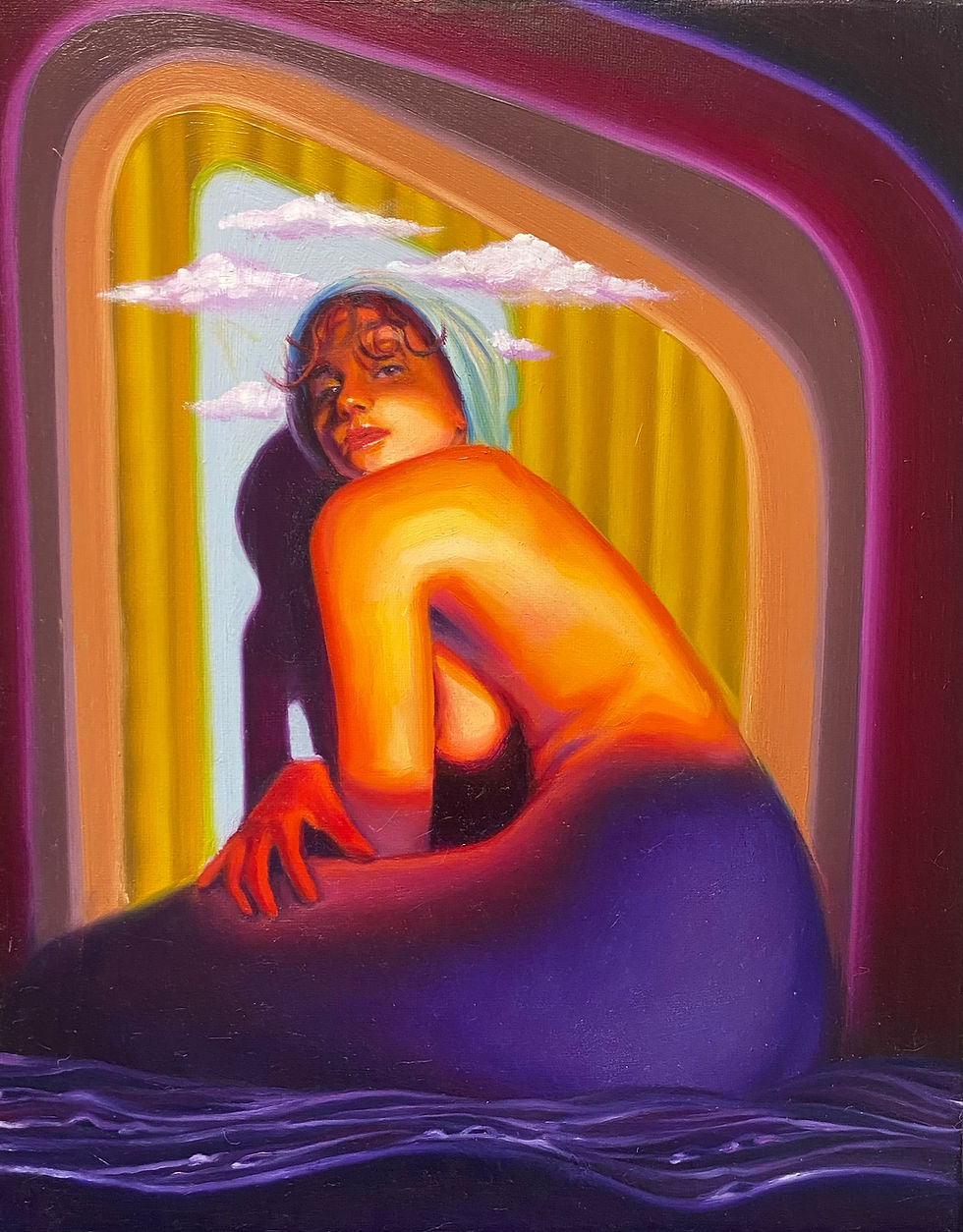
“comfort zone“ oil on canvas 20x16“ *sold
Q: Let’s start with a fun icebreaker: If you could invent a new color based on an emotion, where would it be placed on the color wheel, what would it be called, and why? A: Fun question! So if clarity was an emotion, it would be in the blue-violet range in the color wheel, BV27 I would call it the kind of color you would see in outer space or while stargazing. Because I feel a deep calm whenever there’s enough clarity, I can see the stars in the night.
Q: Can you tell us a little bit about your background and how you came to be an artist?
A: Art started being a tool of expression from a very young age, drawing cartoons and Pokémon, interpreting what I really liked on paper. Later came a deeper understanding of art when my grandfather visited my mom and me from Venezuela and taught me the basics in oil painting and how to look at art. That became the foundation of my curiosity for graffiti and muralism in Puerto Rico, where “GLOSO” was born. Seeing a lot of graffiti artists and muralists around the mid-2000s was a pivotal time for me and inspired me to create my own world, interpreting and developing a visual language onto the canvas or wall. Ever since, the more art I did, the more the possibilities would present themselves.

Q: Coming from a graffiti background, where letters were central, how do you approach communicating ideas visually through form, gesture, and composition today?
A: Letters have energy and movement. From their shape to their rhythm, they communicate mood, emotion, and style. Graffiti taught me how personal a visual language can be, often becoming an alter ego through a name or symbol.
Q: Your work suggests constantly shifting states of being. Do you see identity as something fixed or something fluid?
A: I see identity as fluid. Change is always happening through experiences, decisions, and relationships. Sometimes it is loud, sometimes it is quiet, but it is constant. Fluidity allows me to experiment and grow.
Q: Anatomy and vulnerability appear frequently in your work. What makes these subjects compelling to you, and how do they help you communicate emotion?
A: Anatomy and vulnerability are protagonists in my narrative. I utilize these ideas to show the complexity of the human condition beneath the socially acceptable mask to the beauty of self-acceptance. With vulnerability, I explore the surfaces of the subconscious to reveal the psyche (the true self), and with anatomy, both act as a form of confession, maybe too much for their own good, but fully human is raw and often a mess that I am interested in untangling.
“Inner thoughts" oil on canvas 14x11“ "Silent Judgement" Oil on canvas, 14x11" (2024) “save yourself” oil on canvas 14x11” 2024 SOLD “kiss of death" Oil on Canvas, 10x8” (2025)
Q: You’ve spoken about art helping you develop awareness and think for yourself, despite external influences. Can you talk about a moment or period where art reshaped the way you see yourself or the world?
A: Early on, while living in Puerto Rico, I reached a point where I had to choose between continuing to make work that felt safe or taking a risk and pushing my visual language further. Choosing growth over comfort changed how I saw myself as an artist. It taught me to trust curiosity, and that decision continues to guide me.
Q: As we come to the end, what themes or questions are you excited to explore in your future work?
A: Great questions! I would say that right now I am looking into more controlled color palettes in my paintings, making color more intentional and with purpose — with the question of creating harmony or chaos.

Gabriel Nieto’s work continues to explore the intersection of figurative painting and psychological storytelling, showing how anatomy and vulnerability can reveal unexpected truths about the human experience. His paintings are the result of years of practice, observation, and reflection, and they highlight the careful balance between emotion, form, and color. As he continues developing his visual language and experimenting with new ideas, Nieto remains focused on creating work that feels honest and human. His practice demonstrates how contemporary art can engage with both emotional and conceptual depth, offering a perspective that is personal, yet universally relatable.

To see more of Gabriel Nieto's incredible work and stay updated on his latest projects, be sure to follow him on Instagram and visit his website!
Disclaimer:
The views, opinions, and perspectives expressed by artists featured, interviewed, or presented on this site are solely those of the respective individuals. They do not necessarily reflect the views, beliefs, or opinions of Selfless Art Gallery, its staff, or affiliates.


Comments