
How Contemporary Artist YooYen Nam Explores Human Emotion Through Painting
- 4 days ago
- 6 min read
Updated: 19 hours ago
In much of contemporary art, the human figure is used as a vessel for exploring emotion and connection. NYC‑based artist YooYen Nam uses round‑faced, gender‑neutral characters and psychologically charged scenes to examine existential anxiety, cultural duality, perception, and the search for meaning. She draws on personal experience to ground these themes in something intimate and real. In this interview, we look at how her practice has evolved over time, the symbolism behind her wide, expressive eyes, and how introspection and small visual cues shape paintings that encourage us to look a little closer.

Q: Let’s start off with a fun icebreaker: If your figures could ask for benefits, would they want dental, vision, or existential clarity?
A: Haha, that is such a brilliant question. I think my figures would first demand vision benefits. But it’s not just about having 20/20 physical sight; they’d want the kind of vision that allows them to see “existential clarity.” Of course, since that kind of clarity is fundamentally unattainable, they would probably keep coming back to ask for more. They’d be frustrated, wondering why their life’s meaning remains so blurry even though their eyesight has improved. Eventually, I think they’d even end up demanding “brain rewards,” neurological compensation, just to cope with that gap.

Q: Can you tell us a little bit about your background and how you came to be an artist?
A: I actually started my academic journey studying Business in Korea. My original plan was to go into arts management or become a film producer, but everything changed when I attended a lecture by a film director and producer. Watching them speak, I had a sudden realization: I didn’t want to be the producer managing the art; I wanted to be the “director,” the creator behind the work. Driven by this newfound clarity, I returned to my first love: art. In Korea, I began with watercolor drawings but felt a strong urge to explore other mediums. After experimenting with Eastern ink painting, acrylics, and oils, I discovered that oil paint resonated most deeply with my creative voice. To broaden my horizons, I moved to the United States to study oil painting in a more diverse artistic environment. This path led me to earn two bachelor’s degrees, one in Business and one in Fine Arts (Painting). While a degree alone doesn’t make someone an artist, the technical foundation, discipline, and networking guidance I gained in school have been invaluable. Since graduating, I’ve continued to develop my practice through constant painting, residencies, and exhibitions.

Q: During your academic years, you often had to imagine figures rather than work directly from observation. How did that shape the way you construct and understand your subjects today?
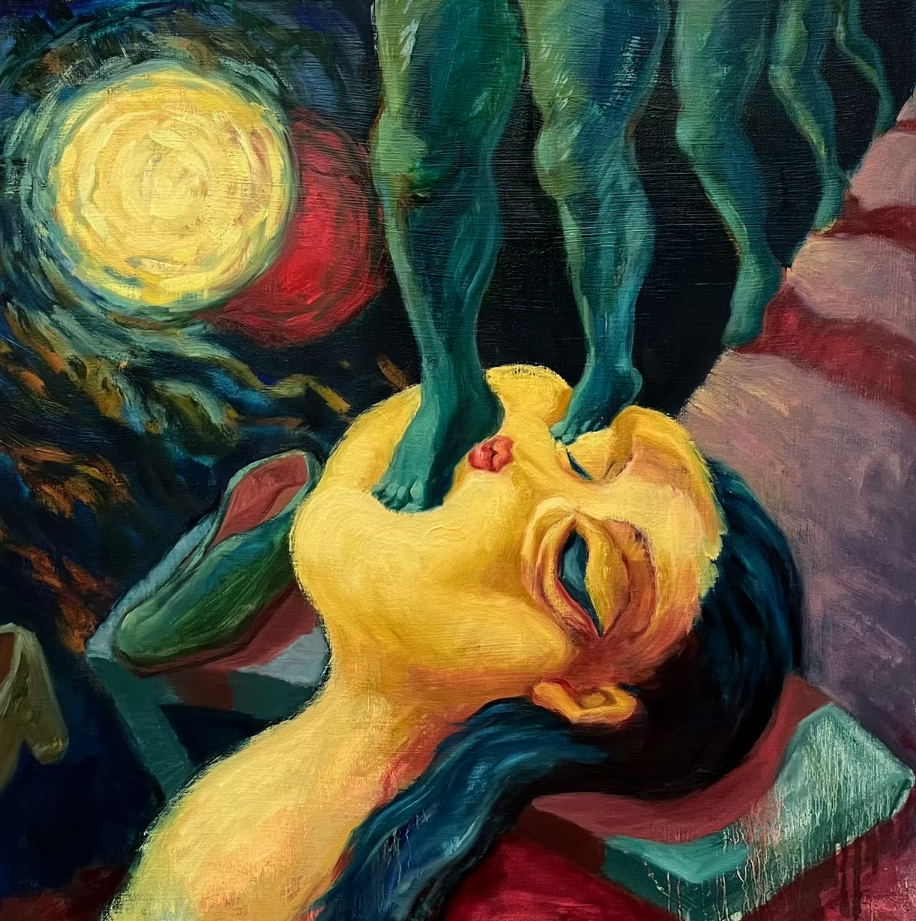
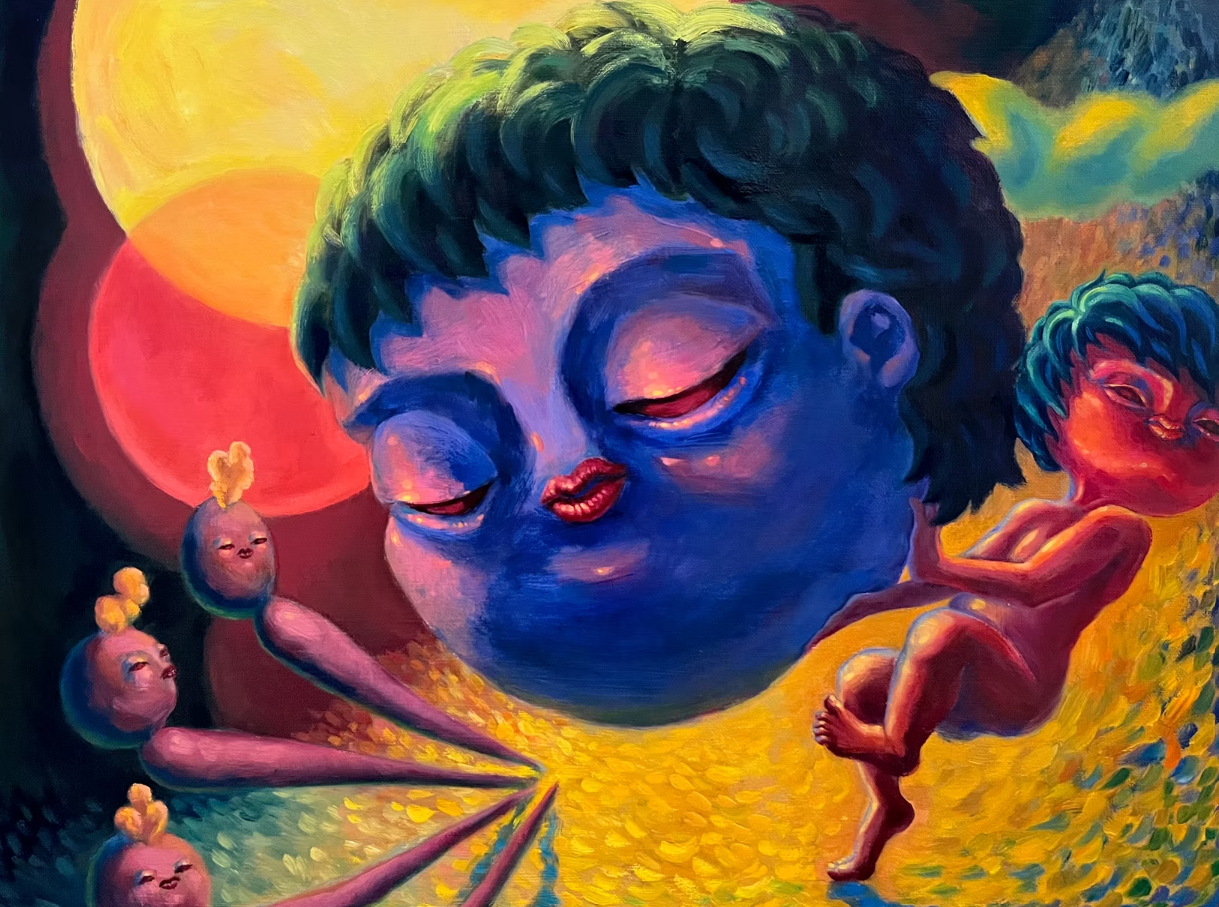
A: I’ve always been drawn to the human figure, but not to portraying a specific person. Instead, I was fascinated by abstract ideas such as the universal human experience and the intricate nature of relationships. In my early work, the figures are not traditional portraits and are unrecognizable as individuals. Anatomy classes later helped me internalize the body’s structure so I could construct figures from imagination, and the intensive drawing in Etching pushed me to experiment through repetition and distortion. Through this process, my current figures emerged: round‑faced, nose‑less, gender‑neutral characters who are cute yet often in states of suffering or violence. These forms finally allowed me to express the universal themes I had been chasing without tying them to any specific person. I believe that the meaninglessness of life, the beauty of creating our own meaning, and the paradox of being close to someone yet fundamentally unknowable are best conveyed through these non‑specific figures.

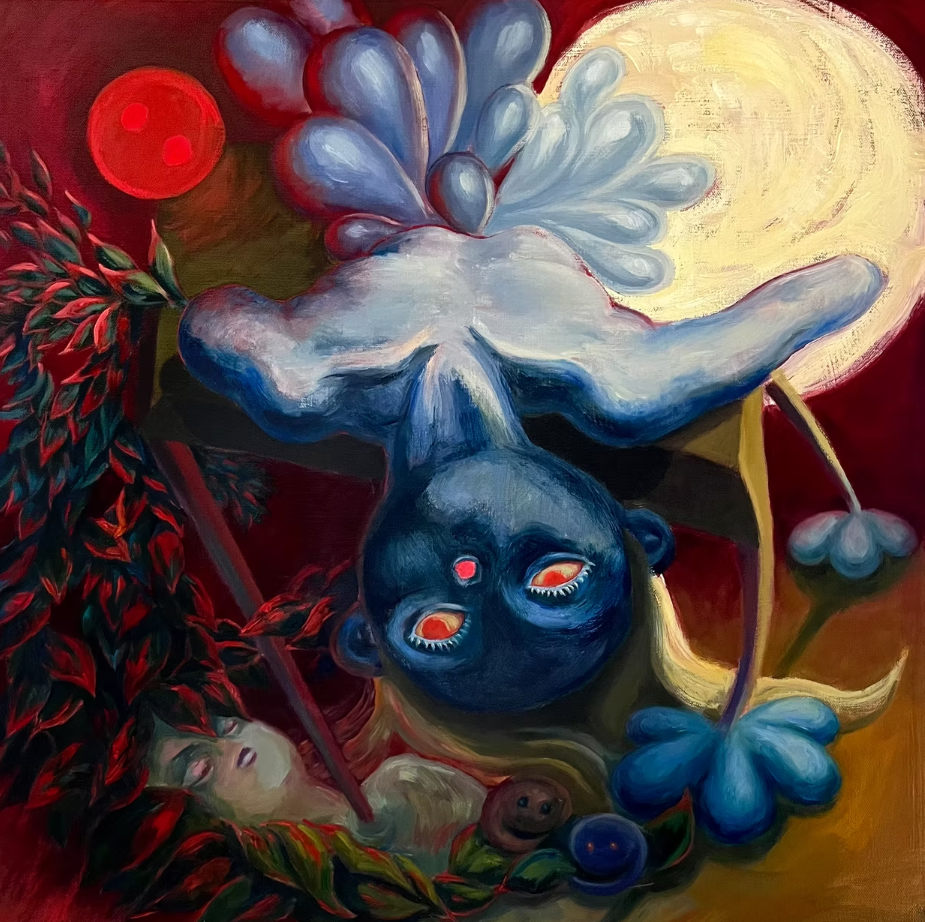
Q: The eyes in your work seem to hold so much of the figure’s emotion. What do they represent?
A: The eyes in my work stem from my personal navigation of cultural differences. In many Eastern cultures, direct eye contact can be seen as confrontational or discouraged, whereas in the West, it is often seen as a sign of confidence and connection. Navigating these contrasting norms created tension for me personally.
Beyond that, I wanted to challenge the old adage that “the eyes are the windows to the soul.” We often believe that by looking into someone’s eyes, we can truly know them. However, I believe that even when we look directly at someone, we can never fully grasp the depths of their being. Our judgments are often clouded by our own biases and perspectives. By emphasizing these wide, staring eyes, I highlight the impossibility of fully knowing a person or situation at a glance. It is a reminder to avoid hasty judgments and to approach others with more patience, compassion, and openness.







Q: As someone who describes themselves as introverted, how does that influence the way you approach connection through your paintings?
A: As an introvert, it’s naturally difficult for me to dive straight into deep, philosophical conversations about human existence with people. However, I find that my art acts as a bridge. At exhibition openings, my paintings become the starting point, making it easier to open up about these topics. While my introverted nature sometimes makes me feel like an actor playing a role in social settings, I am deeply fascinated by the universal emotions we all share: solitude, existential anxiety, the search for meaning, and the desire for recognition.
While I can express myself through words, there are certain things words simply cannot capture, which is precisely why I paint instead of write. Painting allows me to share those indescribable things more freely. I also consider my introversion a strength. It allows me to retreat inward and spend time discerning where my own thoughts end and the influence of others begins. This introspection helps me empathize with the inner worlds of others and explore deeper themes in my work.

Q: When someone spends time with your work, what layers or subtleties do you imagine rising to the surface?
A: Above all, I need to thank the people who spend time with my work. As a maximalist, I love art that is layered and complex, work where you can discover something new each time you look at it. I want to offer that same experience to viewers. Our senses are easily deceived, and we often process things through our existing prejudices before moving on. I want to create moments where overlooked details are rediscovered on a second or third viewing. A key example is the number of fingers on my figures. I often vary the count as a rebellion against normalcy and to expose the tricks our perception plays on us. It’s fun to watch people realize there are more than five fingers or toes, or notice that my figures lack noses or pupils. Beyond the philosophical layer, I want to provide the tactile joy of finding hidden details, much like a “hidden object” game. I believe a good painting should be sensory and engaging even for a child, while still offering depth to those who bring their own observation and life experience to the work.
Q: The question that sits at the heart of my practice right now fill in the blank.
A: How can understanding be so inherently shallow, yet so incredibly warm at the same time?I’ve been thinking about how we survive through the accumulation of thin layers of understanding. It’s not about grand salvation or a singular moment of enlightenment, but accepting that we can never fully reach the depths of another person while still choosing to live within the warmth of that effort. To me, that repeated warmth is a more real and vital salvation than any distant, perfect grace.

YooYen Nam’s layered compositions and unconventional figures, often defined by their wide and expressive eyes, remind us to pause and look beyond first impressions. Her work asks us to notice what we assume, what we overlook, and how easily we can misread someone at a glance. As contemporary art continues to shift, Nam’s practice shows how painting can still hold space for emotional honesty and shared human complexity. That same spirit carries into the workshops she hosts throughout NYC, where participants build collages using the body parts found in her figures, creating their own playful interpretations.
To see more of YooYen Nam’s work and stay up to date on the workshops she offers, follow her on Instagram!
DISCLAIMER:
The personal views, opinions, and perspectives expressed by artists featured, interviewed, or presented on this site are solely those of the respective individuals. They do not reflect the views, beliefs, or opinions of Selfless Art Gallery, its staff, or affiliates.


Comments